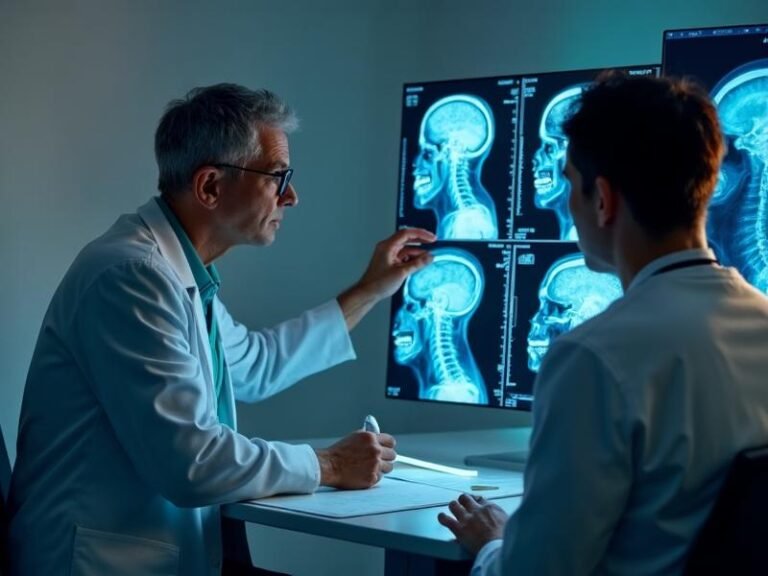
Endoscopic cervical spine surgery: a smaller-incision option, where suitable
For selected neck problems, an endoscopic approach may allow the nerve to be freed through a very small opening. Dr. Rajesh Pathi will explain whether it suits your case and how it compares with other approaches.
When to seek emergency care. New loss of bladder or bowel control, numbness around the saddle area, or rapidly worsening weakness in the legs need emergency care. Call 108 or go to the nearest emergency department.
Endoscopic surgery suits some neck problems, not all
Whether an endoscopic approach is sensible depends on the exact problem, its position and your scans. Sometimes a different technique is the better choice, and that will be explained honestly.
What to know about endoscopic cervical spine surgery
General information to help you ask the right questions — not a substitute for your own consultation.
What does 'endoscopic' mean?
Surgery done through a narrow tube with a small camera, rather than a larger opening.
Why consider it?
It aims to reduce disturbance of surrounding tissue, where it is suitable.
Who might be considered?
Selected people with a nerve being pressed in the neck, judged on scans and symptoms.
What are the limits?
Not every neck condition can be treated this way.
What shapes the recommendation
The condition
Which problem is being treated and where.
Scan findings
Anatomy and position of the pressure.
Your symptoms
Pain, numbness or weakness.
Alternatives
Other approaches and conservative care.
What endoscopic cervical surgery involves
Done under anaesthesia, with a very small incision where suitable.
A narrow working tube is placed through a small opening.
A camera lets the surgeon see the nerve and the disc.
The tissue pressing on the nerve is removed.
You are monitored and guided through early recovery.
Your journey, stage by stage
Assessment & scans
Your symptoms, examination and imaging are reviewed together.
Options & risks discussed
An honest conversation about surgery, alternatives and risks.
Preparation
Clear instructions about medicines, fasting and what to expect.
Anaesthesia & set-up
Careful preparation with continuous monitoring.
The operation
Carried out with precision, tailored to your case.
Close observation
Monitoring straight afterwards.
Early recovery
Guidance on movement, wound care and warning signs. Timelines vary.
Rehabilitation
Support to regain strength and function where needed.
Follow-up
Review of how you're recovering, with scans if appropriate.
Want to be sure before deciding?
A second opinion before an operation is common and welcome. Learn how second opinions work at Anoki.
Learn About Second Opinion Services
Dr. Rajesh Pathi
Dr. Pathi is a Fellow of the Minimally Invasive Spine Surgery society (FMISS) and explains clearly when a minimally invasive approach fits and when it does not.
Questions people often have
No. It is one option and is chosen only where it is a sound fit.
The incision is small, but a scar is still expected.
This depends on your case. Dr. Pathi will explain.
Other approaches or non-surgical care will be discussed.
Want to talk through endoscopic cervical spine surgery?
Book a consultation with Dr. Rajesh Pathi at our Pragathi Nagar clinic.